Whiskers at the Corner Store: The Unofficial Mascots of Tojinmachi (and the Neighbors Who Feed Them)
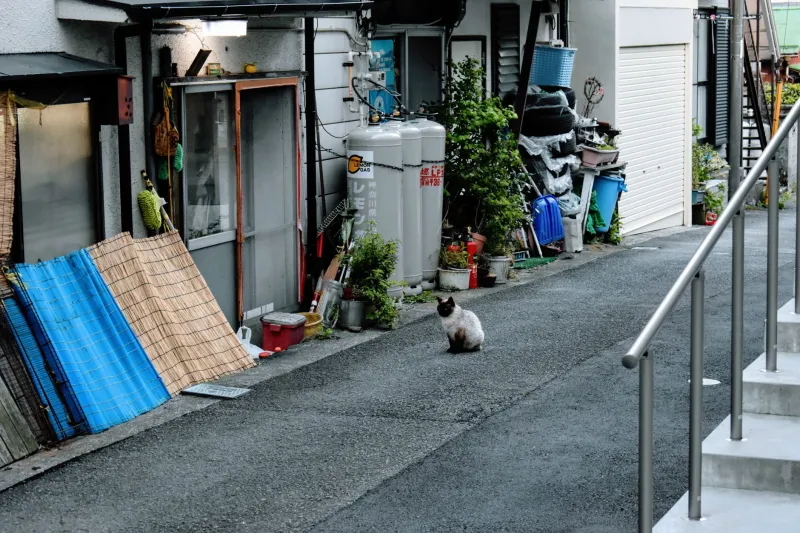
There's a tabby who lives, as far as anyone can tell, outside the dry cleaner on the Muromi side of the neighborhood. I don't know her name. That's the thing — I know of her, I've seen her maybe forty times, but I've never once heard anyone call her anything. She's just the dry cleaner cat, and everyone within three blocks knows exactly who you mean when you say it.
If you've spent any time in Japanese residential districts, you already know this phenomenon. If you're new to Tojinmachi — especially if you've arrived from a US suburb where dogs have Instagram accounts but neighbors don't know each other's names — the animal infrastructure of a place like this can be quietly astonishing.
The Roster
Let me introduce you to a few of the regulars, in the spirit of a field guide.
The dry cleaner tabby, mentioned above, holds court on a plastic crate between 2 and 5 p.m. She accepts chin scratches from regulars and cold shoulder from everyone else. Consistency is her brand.
The gate shiba. An older gentleman on my walking route keeps a shiba inu who does not bark, does not run, and does not care about you — but positions herself at the gate every morning at exactly the hour you pass, like a furry crossing guard. I've nodded at that dog more times than I've nodded at some of my actual neighbors.
The shrine cats. Near the small neighborhood shrine, there are usually two or three cats rotating through the sun spots. They are fed, visibly and regularly, though I've never caught the feeder in the act. More on that in a second.
The crow situation. Okay, the crows are not mascots. The crows are a rival faction. But they're part of the ecosystem, and you'll develop opinions about them faster than you expect.
The Secret Treat Stashes
Here's where it gets charming. Walk the backstreets slowly — slower than feels natural — and you'll start noticing them: small covered containers, repurposed plastic bins, sometimes a little hand-written sign, set beside gates and under eaves. These are feeding stations. Some are elaborate; most are humble. A water bowl here, a scoop of dry food there.
The people behind them are, disproportionately, the neighborhood's older residents. The woman two doors down from the shrine feeds the cats every morning at 6:30, rain or shine — I know because my first month here, jet-lagged and desperate for convenience store coffee, I kept seeing her. We've never had a full conversation. We have an entire relationship built on bows, smiles, and the shared understanding that the fat white one is the boss.
In the US, this would arguably be a code enforcement issue. Here, it's just... how the neighborhood breathes.
What the Cats Are Actually Doing
I've thought about this a lot, and I think the animals function as low-stakes social glue.
Consider the mechanics of it. You can't walk up to a stranger in Fukuoka and start a conversation — that's true in most of Japan, and honestly in most of the US too. But you can both look at the same cat. You can both do the little exhale-laugh when it flops over. You can both nod at the feeding station. Over months, that becomes recognition. Recognition becomes a greeting. And one day, when you're hopelessly lost trying to find a package drop-off point, the shiba's owner is the person you can ask.
Sociologists call this "weak ties" — the casual acquaintances that make a neighborhood feel like a place rather than an address. In American suburbs, we've largely outsourced weak ties to retail workers and Facebook groups. In Tojinmachi, the cats are doing the work.
There's also something else going on: the feeding stations are a form of visible, unspoken care. Nobody brags about them. Nobody posts about them. They're just there, like the trash schedules and the flower pots on the corner. It's the same ethic I've written about before with the bulletin boards and the giveaway culture — this neighborhood runs on small, anonymous maintenance.
A Note for Newcomers (Especially Americans)
A few ground rules, learned gently:
- Don't feed the cats yourself. The stations are managed; adding random food causes problems, and some of the cats are part of managed TNR (trap-neuter-return) programs with notched ears as the tell. Admire, don't administer.
- Ask before petting. Not the cat — the owner, if there is one. A smile and a gesture toward the dog goes a long way.
- Learn the local names by location, not label. "The bakery cat," "the gate shiba." You'll be understood instantly.
- The nod matters. Repeated small acknowledgment with a neighbor — even a silent one mediated by an animal — is how you become part of the scenery in the good way.
Why This Hits Different Back Home
I grew up in a place where every house had a dog and nobody knew any of them. Here, a cat I've never touched has made me feel like I belong to a block. That's not sentimentality — that's infrastructure, the social kind, the kind that doesn't show up on rent listings but absolutely affects what a neighborhood is worth.
So if you're apartment hunting in Tojinmachi and you see a plastic feeding bin by the gate next door, don't read it as a red flag. Read it as evidence: somebody here has been showing up, quietly, every single morning for years.
That's the kind of block you want to live on. The dry cleaner tabby agrees.