Scissors, Nods, and a Photo on My Phone: Surviving My First Tojinmachi Haircut
I put off my first haircut in Japan for eleven weeks. Eleven. Weeks. I told myself it was because I was busy, but really I was scared of walking out with something I'd have to hide under a hat until it grew back. If you've just moved to Tojinmachi and your hair is starting to file a formal complaint, this one's for you.
The Fear Is Real, but Mostly Imagined
Here's what nobody tells you: Japanese barbers cut foreigners' hair all the time. You are not the first American to sit down and shrug helplessly. The whole interaction runs on a system of gestures, photos, and universal barbering shorthand that predates both of us. The scissors speak a language of their own.
My mistake was waiting so long. By the time I finally pushed open the door of a tiny shop two blocks from Tojinmachi Station, I had enough growth on my head to qualify as a cautionary tale.
Decoding the Menu Without Reading It
Most neighborhood shops around here post a price board near the door, and even without kanji skills you can crack it. Look for the numbers: a basic cut (カット) usually runs ¥1,000–¥2,000 at the no-frills places, while a barbershop with a hot towel and face shave (髭剃り) might run ¥2,500–¥4,000. If you see 顔剃り or シェービング, that's the shave — and honestly, the hot towel shave alone is worth the visit.
Word of warning about the legendary "sanbun no ichi" disaster: a friend of mine, trying to be precise, asked them to cut "a third" off. The barber took him literally. Three inches became eight. Don't do math at the barber. Bring a photo instead — it's the single most reliable translation tool ever invented.
The Phrase That Saves Every Hairline
If you learn exactly one line of Japanese for this mission, make it this one:
"Onaji you ni onegaishimasu" — "Same as this, please," said while showing a photo on your phone.
Pair it with "sukoshi dake" (just a little) if you're nervous, and "migite mo onegaishimasu" is unnecessary — nobody's asking about your right hand. Keep it simple. A screenshot of your last haircut from back home, maybe a back-of-head photo too since that's the part you can't see, and you've communicated more than a semester of language school could.
A Few Foreigner-Friendly Spots Near the Station
I'll keep this general because shops come and go, but these types are reliable bets in the neighborhood:
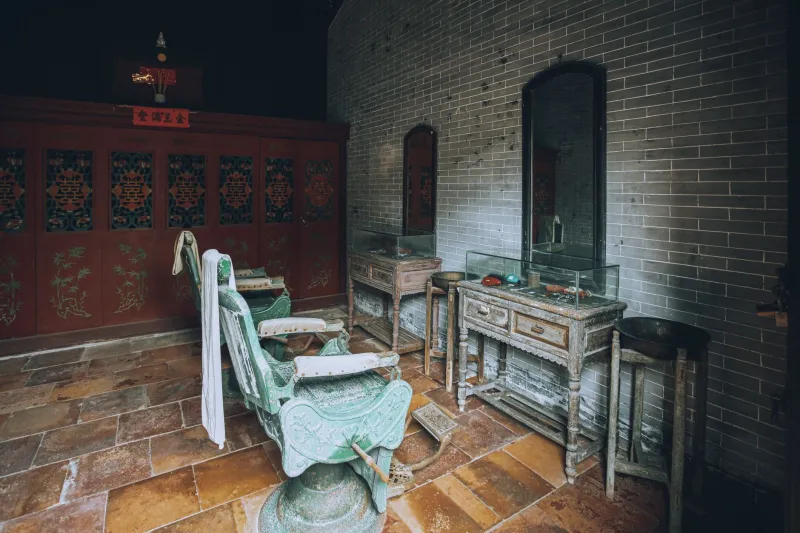
- The old-school barbershop with the red-white-blue pole. The barber has cut hair for forty years and has seen every kind of head. Point, nod, done. Expect the hot towel and a cigarette-scented time machine.
- Chain salons like the ones near the subway exits. English-friendly, app booking, consistent results. Less charm, zero risk.
- The barbershop inside or near the shopping arcade. Often run by a second-generation owner who studied English in school and is quietly delighted to use it.
Walk the streets between Tojinmachi Station and the Muromi River and you'll pass at least four of these without trying.
Booking, Tipping, and Other Etiquette Notes
Small shops often take walk-ins; if there's a slot board by the door, stick your name in an open slot. Chains let you book online, sometimes even in English.
Now the big one Americans always ask: do not tip. Not a little, not "keep the change," nothing. It genuinely confuses people here and can turn into an awkward chase to return your money. The price on the board is the price. Pay, say "gochisousama" or just a warm "arigatou gozaimasu," and bow slightly on your way out.
Also: expect the cape, then the chair reclined, then possibly a scalp massage that lasts longer than the cut. Surrender to it. This is not a bug; it's the feature.
The Weird Part: When You Start Feeling Like a Regular
My third visit, the barber remembered I take it short on the sides. My fifth, he asked — via gestures — whether I'd been running, because my hair was thinner from sweat. That's the moment it clicked: the barber chair is one of the fastest shortcuts to feeling like a local. No language test, no small talk pressure. Just a person who sees your head once a month and quietly takes care of you.
My haircut still isn't perfect. But it's mine, it cost about fifteen bucks, it came with a shoulder massage, and the man with the scissors knows me now. Eleven weeks of fear for that trade? I'd make it again tomorrow.